How extra virgin olive oil is made, step by step in a two-phase mill
From trailer to bottle: cleaning, milling, malaxation, decanter and tank. What each stage decides and where the quality is lost.
Written by The Villafranca Bonilla family8 min read
By crushing the olives and separating the oil by centrifugation, with no heat above 27 °C and no chemical of any kind. That is the entire process, and it is why extra virgin is legally a fruit juice rather than a manufactured oil. What decides quality is not some industrial secret: it is four or five very specific decisions spread along the way.
Here is the whole route, from trailer to bottle, flagging at each stage what can be lost.
Before it starts: what is already decided
Worth saying, because it carries the most weight and none of it happens at the mill.
By the time the olives reach the yard, two of the three most important decisions have already been taken: when the fruit was picked and how long it took to get there. A mill can ruin good olives; it cannot rescue bad ones.
- Ripeness sets the fruitiness, bitterness and pungency. Green gives less oil and far more character.
- Elapsed hours determine whether there will be a fusty defect. Olives are fruit, and fruit heaped up ferments within hours.
With that understood, the process begins.
1. Reception and cleaning
The olives arrive by trailer and the first job is removing everything that is not an olive.
Blowing and screening separates leaves, twigs and sticks. Leaf is not harmless: in excess it gives the oil a harsh herbaceous bitterness and a greenness that does not come from the fruit.
Washing with water, if the fruit carries soil. A detail few people know: clean fruit picked from the tree is often not washed at all, because water means added moisture and moisture helps nothing downstream. What needs washing gets washed.
And separation by quality. Fruit picked from the tree and fruit gathered off the ground should never go in together: ground fruit carries soil, moisture and frequently fungi, and drags the whole batch with it. If you see two separate lines at a mill, that is a good sign.
2. Milling
The olives are crushed whole, stone and all, into a paste.
Old mills used stone wheels turning on a bed. They worked slowly, with little heating and little oxidation, and some people still defend them. They are slow and hard to keep clean.
Modern mills are hammer or disc mills: the fruit goes in and comes out as paste in seconds. Fast, continuous and easy to keep hygienic.
What gets decided here is particle size. A finer grind releases more oil — higher yield — but also releases more bitter compounds from the stone and generates more frictional heat. A coarser grind yields less and gives a finer oil. This is the first point where you choose between litres and flavour.
And the oxidation clock starts here. The moment the fruit is broken, its enzymes meet air. Everything that follows is a race.
3. Malaxation: where most of it is won or lost
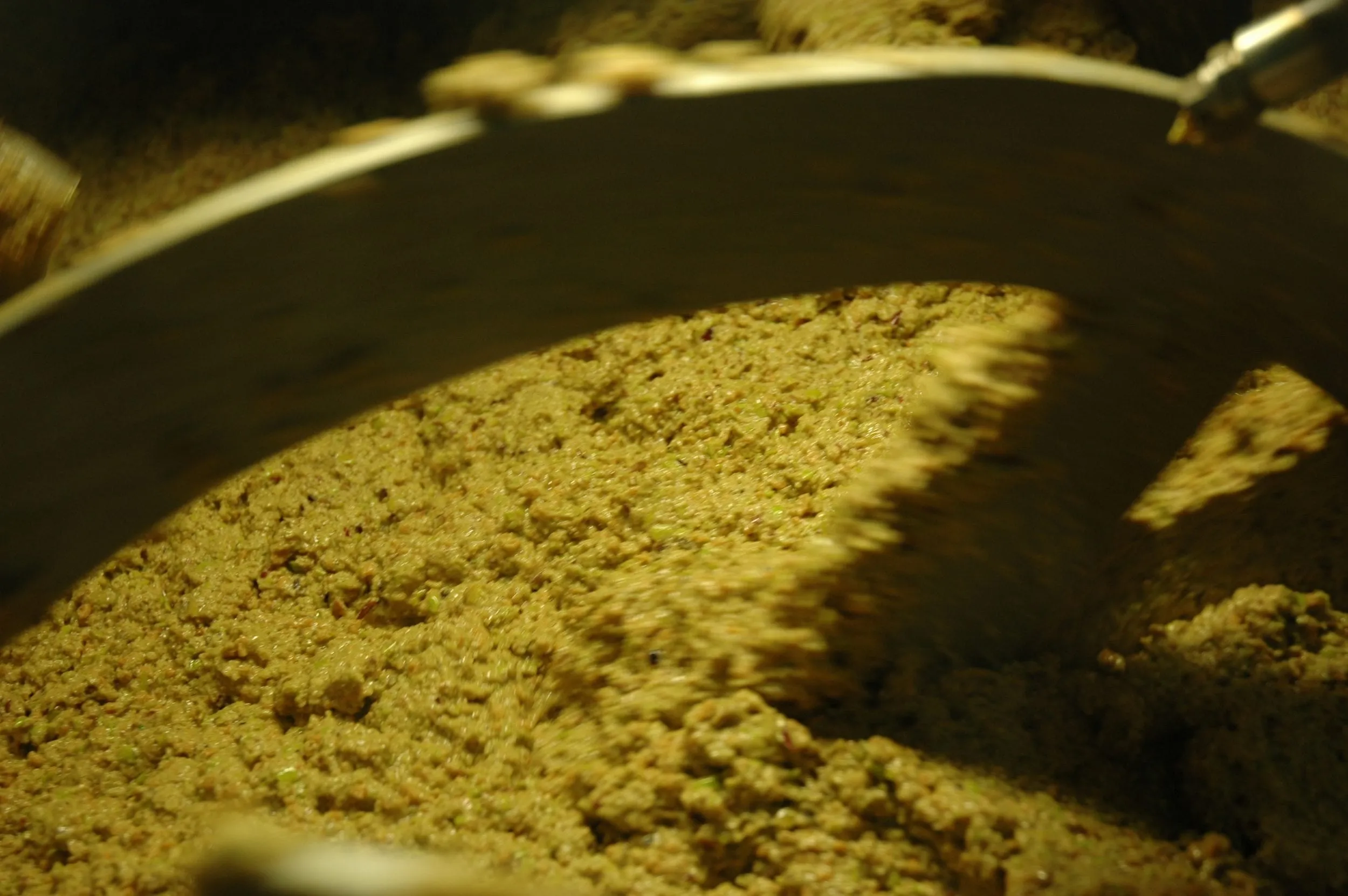
The paste passes into the malaxer, a trough with a slow-turning shaft. It looks like the dullest step and it is the most decisive.
What is happening inside: the oil sits in microscopic droplets dispersed through the paste, too small to separate. Slow stirring lets those droplets find each other and merge into larger ones that can actually be extracted.
Two variables, and both are compromises:
Temperature. Warming the paste makes the oil more fluid and raises the yield substantially. It also accelerates the loss of volatile aromatics and phenolic compounds. Below 27 °C is “cold extraction” and can be declared on the label; above it, neither declarable nor the same in the glass. Running at 30 or 32 °C produces extra litres that show up nowhere except the accounts.
Time. A longer malaxation also raises yield, and also exposes the paste to air for longer, so it oxidises more. Thirty to forty-five minutes is typical; stretching to an hour and a half extracts more oil and worse.
We extract cold, below that 27 °C. It is one of those decisions that costs yield and is invisible in the bottle until you open it.
4. The decanter: separating
The malaxed paste enters the decanter, a horizontal centrifuge spinning at high speed that separates the components by density.
Two-phase (standard in Spain today): out come oil and alperujo, a wet paste combining the solids and the vegetation water. No water is added.
Three-phase (the older system): water is added to assist separation, and out come oil, dry pomace and alpechín, a dark liquid waste.
Two-phase wins on two counts. The environmental one is obvious: that liquid waste was for decades a serious source of watercourse pollution. The other is quality: the water added in a three-phase system washes out phenolic compounds, which are water-soluble. Less water means more of what gives bitterness, pungency and keeping quality.
5. Vertical centrifuge
Out of the decanter the oil still carries some moisture and fine solids. A vertical centrifuge gives it a second pass and leaves it clean.
Purely mechanical. It is also where some mills add warm water to help, with the same trade-off as always: more clarity, fewer phenolics.
6. Tank, settling and filtering
The oil goes into stainless steel tanks, and three unseen things matter here:
That they are full. A half-empty tank has a head of air above the oil and it oxidises against it. Serious mills size their tanks to fill them, or blanket the headspace with nitrogen.
That they are dark and at a steady temperature. The same four enemies as in your kitchen — light, heat, air and time — operate identically in a cellar.
That they are clean. Residue from the previous season contaminates the new one and is a classic source of the winey defect.
Then, settle or filter. Fresh oil carries particles and moisture in suspension; it can be left to drop and racked off, or passed through a filter. Unfiltered has slightly more fruitiness in the first months and considerably less shelf life.
7. Analysis and tasting
Before bottling, the batch is checked two independent ways, and both are needed.
Physicochemical analysis measures free acidity, peroxide value and ultraviolet absorbance among other parameters. It tells you whether the oil is sound and whether it has oxidised.
Tasting is done by a trained panel, using opaque blue glasses so colour cannot influence the verdict. It scores fruitiness, bitterness and pungency, and hunts for defects.
And here is the crux of the whole system: to be extra virgin an oil needs both at once — fruitiness above zero and zero defects. An oil can return a flawless analysis and be fusty; the numbers do not detect fustiness, only a nose does. This is why the tasting is mandatory rather than decorative. The categories are set out in what extra virgin actually means.
8. Bottling
The last step, and where everything above can be thrown away.
Opaque container: tin or dark glass. Light is the most aggressive enemy and the most ignored.
Filled to the top, with minimal air in the neck.
And as close to consumption as possible. Oil kept well in a tank holds up better than oil bottled and waiting months on a lit shelf.
What comes out besides oil
A detail that surprises visitors: oil is the smaller part of what leaves a mill.
Roughly speaking, only a modest fraction of the weight of the fruit becomes oil. The great majority leaves as alperujo — the wet paste of skin, pulp, stone fragments and vegetation water that comes out of a two-phase decanter.
That material is not waste in the modern sense. It goes to extraction plants where the residual oil is recovered with solvents to produce olive pomace oil, a different and separately regulated category. What remains after that is used as biomass fuel, as compost, and increasingly as a raw material for extracting compounds of interest.
There is also the leaf and twig removed at cleaning, which typically goes to animal feed or compost.
Worth knowing for two reasons. It explains why olive pomace oil exists at all and why it is not the same product as anything described in this article. And it explains part of the cost structure: a mill that treats its by-products properly is running a second small industry alongside the first.
Where quality is lost, in order
Summarising all of the above by weight:
- Olives heaped up before milling. The gravest and commonest failure in the world.
- Picking too late, if character is what you are after.
- High malaxation temperature to raise yield.
- Over-long malaxation, for the same reason.
- Dirty or half-empty tanks.
- Clear glass and months on a shelf.
Notice that none of these is a difficult technical problem. Every one is a choice between extracting more litres and making better oil, taken by someone at a specific moment. That, fundamentally, is all that separates one oil from another.
500 ml bottle
Dark glass. Our everyday size.
€12.50€25.00 per litre
See the half-litre bottleFrequently asked questions
- How is the oil extracted from the olive?
- By mechanical means only. The fruit is cleaned, milled whole including the stone into a paste, that paste is stirred slowly so the microscopic droplets of oil coalesce, and the oil is then separated by centrifugation, exploiting the fact that it is lighter than water and solids. No chemical product or solvent is involved at any point.
- What does cold extraction mean?
- It is a regulated term that may only be used when the paste is kept below 27 °C throughout the process. Heat raises the yield — more litres from the same olives — but drives off the volatile aromatics and degrades part of the compounds responsible for bitterness and pungency. Staying cold is a decision that costs litres.
- What is the difference between two-phase and three-phase?
- A three-phase decanter adds water to help separation and produces oil, pomace and a highly polluting liquid waste. A two-phase decanter adds no water and produces only oil and a wet paste. Besides solving the environmental problem, two-phase retains more phenolic compounds, because added water washes them out.
Keep reading
- What extra virgin actually means, and how it differs from virgin and refinedThe three legal categories of olive oil, what separates them, and why the word on the label is the only claim that cannot be fudged.
- Olive oil tourism in Jaén: visiting a family grove during harvestWhat you see in a grove in full harvest, when to go, what to ask, and how a family estate differs from a visitor centre.
- Rain-fed or irrigated olive oil: what changes in the glassWhy a thirsty olive tree makes a more concentrated oil, how much less it yields, and why almost no label ever tells you which one you bought.
Want to taste it?
Everything on these pages ends up in the same bottle: rain-fed Picual from Marmolejo, picked green and milled the same day.
See sizes and prices