Olive oil tourism in Jaén: visiting a family grove during harvest
What you see in a grove in full harvest, when to go, what to ask, and how a family estate differs from a visitor centre.
Written by The Villafranca Bonilla family8 min read
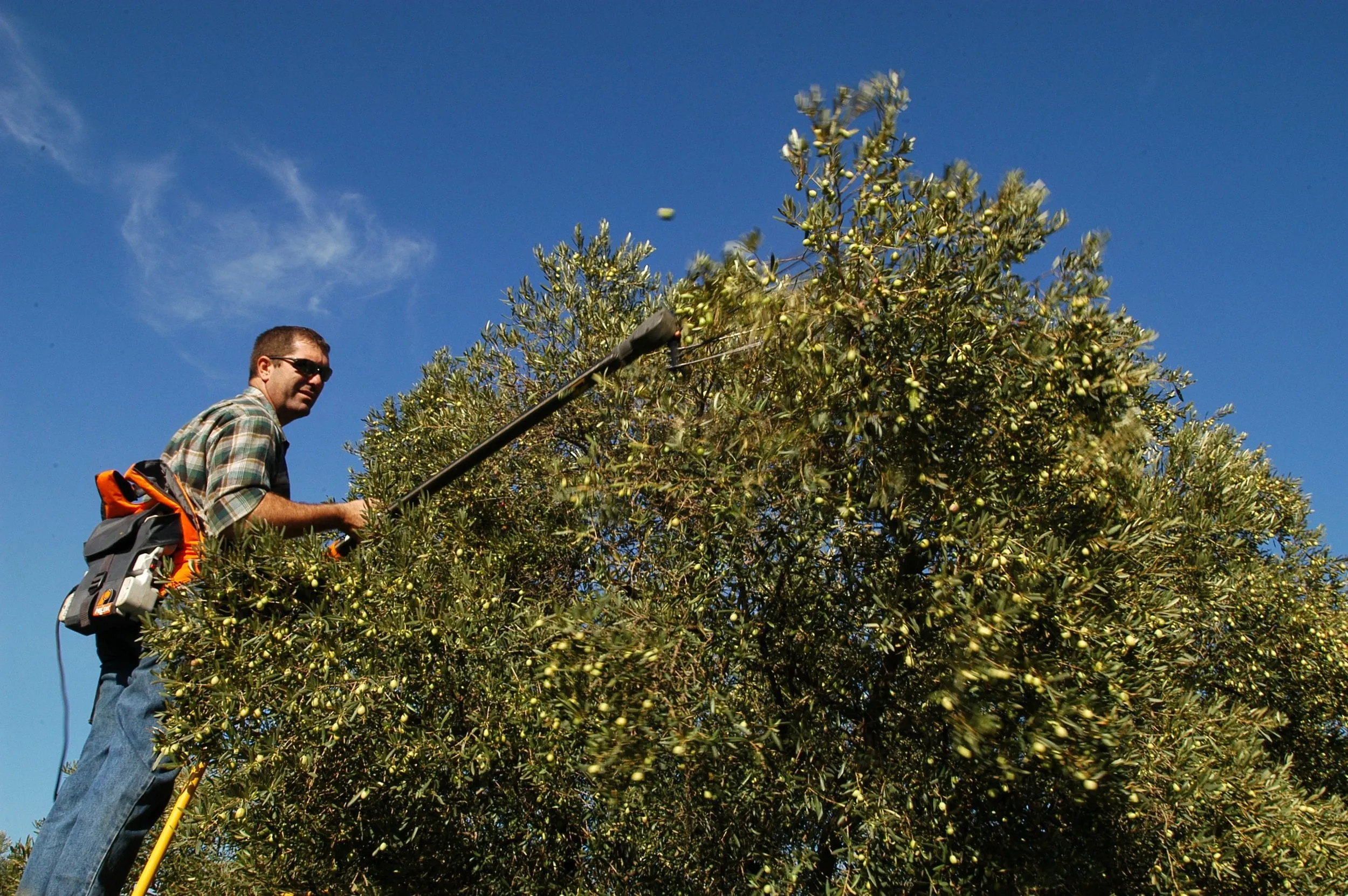
Between November and January, and give notice first. That is the harvest, the only time you see real work: gangs picking, trailers running down to the mill and oil coming out for the first time. Outside those months you can see the grove and the installations, but standing still.
And a useful warning up front: not all olive oil tourism is the same thing. There are visitor centres with a designed route, and there are family estates where what you see is somebody working. Both are fine; it is worth knowing which you are looking for.
The two kinds of visit
The visitor centre. A facility set up to receive people: signed route, guide, tasting room, museum, shop. Fixed hours, online booking, accessibility resolved. Usually large mills or cooperatives with the structure for it.
In favour: it always works, it is well explained, it is comfortable and it suits children or groups. Against: it is a designed visit. You see the process explained, not the process happening.
The family estate. A small holding showing you what it has. No route, no leaflet, often no fixed hours.
In favour: you see what there is. You can ask anything of the person who does it with their own hands, and the answers are specific. Against: it depends on the day and the weather. During harvest there may be nobody free to attend to you, and the terrain is terrain: mud, slope, no toilets and no café.
Neither is better. With small children or anyone with limited mobility, a properly equipped centre is the sensible choice. If what you want is to understand where the oil comes from, the estate.
What you see during harvest, day by day
This is the part people find hardest to picture, so it is worth describing.
The picking. In a mountain grove, on a slope, heavy machinery cannot get in. What you see is a trunk shaker clamped to the tree, nets spread underneath to catch what falls, and people finishing off with poles what remains above. It is loud, it is dusty and it is hard work. In the steepest parcels it is still poles alone.
The transport. The fruit is gathered, cleaned of leaf and loaded. And here is the decision that most determines the oil, one a visitor can see with their own eyes: whether what was picked that morning goes to the mill that same day or sits waiting. Heaped up, olives ferment within hours.
The mill. Cleaning, washing, milling, malaxation of the paste and centrifugation. Paste goes in one end and oil and pomace come out the other. What surprises almost everyone is how undramatic it looks: there are no presses and no stacked mats, there is stainless steel and pipework. And the smell, which is what nobody forgets: the room of a working mill during harvest smells of crushed green olives in a way that cannot be conveyed in writing.
The new oil. It comes out cloudy, green and aggressive, freshly separated. Tasting it there is the best tasting available, even though it is not yet what it will be in a month.
The full process, step by step, is in how extra virgin olive oil is made.
When to go, month by month
| Season | What you see |
|---|---|
| November–December | Green harvest, mill at full tilt, new oil |
| January | End of harvest, riper fruit |
| February–March | Pruning. Less spectacular, but you understand how the tree is managed |
| May | Flowering: the whole grove covered in blossom |
| Summer | Little activity and a great deal of heat. The worst time |
| September–October | Veraison: the fruit turning from green to purple |
If you can only come once, come during harvest. November or early December. It is cold and the days are short, but it is when all of this means something.
What to ask
A visit is worth far more with three or four questions prepared. These get interesting answers:
- When do you start picking and how do you decide the day? It is a decision with many variables and whoever makes it usually has firm opinions.
- How long between picking and milling? The good answer is measured in hours.
- How many kilos of olives make a litre? And how that figure changes between October and January.
- What temperature is the paste worked at? Below 27 °C is “cold extraction”, and running warmer gives more yield and less flavour.
- What do you do with the pomace?
- Do you irrigate? And if not, why not.
And one more that tends to open good conversations: what is the hardest part? Nobody who works the land has a rehearsed answer to that.
With children, and with people who are not interested
Two very common situations worth anticipating.
With children. A grove during harvest usually goes down better than expected: there are machines, there is noise, there are nets on the ground and you can pick olives off the tree. What does not work is the explained part — percentages, acidity, process — or a long tasting. Two practical warnings: a raw olive off the tree is inedibly bitter, and trying one is half rite of passage and half practical joke; and the ground has slope and working machinery, so someone needs to be watching.
If you are bringing small children, a visitor centre with a prepared route is a considerably better idea than an estate in mid-harvest.
With someone along for the ride. It happens often: one of you is interested and the other is not. What works is not to stretch the technical part and to pair the visit with something else: the natural park, a nearby town, a decent lunch. Half an hour of well-told grove leaves a better memory than two hours of process.
And one thing that works on almost everyone, interested or not: smelling the mill room during harvest. You need to understand nothing for that to make an impression.
The tasting, and how to get value from it
Almost every visit ends with a tasting. To make it worth something:
Taste from a glass first, if offered. It is demanding and it is how you perceive the oil with nothing alongside it: warm the glass in your hand, smell it, take a small sip and draw air between your teeth so the aroma rises through the nose.
Then with bread. That is where the oil is genuinely understood, because it is how it gets eaten.
Taste two oils in a row if you can. Comparison is what teaches; a single oil teaches much less.
And do not be alarmed by the pungency. An early-harvest extra virgin scratches the back of the throat a second or two after swallowing, and sometimes makes you cough. It is a positive attribute, not a defect, and it is explained in why olive oil burns your throat.
Sorting it out before you go
Five things that avoid nearly all the disappointments, and which people often forget to ask:
Book, always. Even where it seems unnecessary. During harvest a small holding may have everyone out in the field, and turning up unannounced is the surest way to see nothing.
Ask how long it lasts. Some visits are forty minutes, some three hours with lunch. It is the difference between the day working and falling apart.
Confirm whether you go inside the mill. Not every visit includes the production area, for legitimate reasons: during harvest it is a working zone with machinery running and hygiene requirements.
Ask whether you can buy on site. Many estates sell there and you save the carriage, which with oil is not trivial.
And mention allergies or limited mobility. The terrain of a hillside grove is what it is, and it is better said beforehand than on arrival.
One last piece of common sense: expect poor mobile coverage. Download the location and write down the contact number, because olive-grove tracks are not always well resolved on maps and taking the wrong lane costs half an hour.
Fitting it into the area
Jaén has plenty on offer: mills with organised visits, olive oil museums, cooperatives that open during harvest, and estates that show you their own. It is worth combining with what else is around.
From Marmolejo, within a short radius: the Sierra de Andújar natural park, which holds one of the world’s main Iberian lynx populations, the banks of the Guadalquivir, and a little over an hour away, Úbeda and Baeza, both World Heritage sites. The provincial map is in Jaén olive oil: regions and PDOs.
Our own case, so there is no misunderstanding
We are a small family estate, not a visitor centre. There is no set route, no tasting room, no shop and no opening hours.
What is possible is collecting an order at the estate and, if it fits, seeing the grove. During harvest we may well be out working with nobody free to show anything, so all we ask is notice beforehand, and an understanding that the day’s fruit comes first.
Said plainly, because we would rather that than have someone drive out here expecting something else.
500 ml bottle
Dark glass. Our everyday size.
€12.50€25.00 per litre
See the half-litre bottleFrequently asked questions
- What is olive oil tourism?
- Visiting groves and mills to see where olive oil comes from and how it is made, usually ending with a tasting. It ranges from visitor centres with a guided route, a museum and a shop, to family holdings that show you what they have with no infrastructure at all. They are very different experiences and it is worth knowing which one you are booking.
- When is the best time to visit an olive grove?
- Between November and January, which is the harvest: the only time you see real work, with gangs picking and the mill running. Outside the season you can still walk the grove and see the installations standing idle, which has its own interest but is not the same thing. May offers a different attraction, which is the flowering.
- Can you visit a mill during the harvest?
- Many allow it and some organise it formally, but bear in mind that during harvest a mill works flat out and sometimes without stopping. That means less flexible hours and shorter visits than usual. Book ahead, and understand that the priority is milling the day’s fruit rather than attending to visitors.
Keep reading
- How extra virgin olive oil is made, step by step in a two-phase millFrom trailer to bottle: cleaning, milling, malaxation, decanter and tank. What each stage decides and where the quality is lost.
- Why Jaén produces more olive oil than any country in the worldSixty-six million olive trees in a single province: how it came about, what makes it possible, and the cost of depending on one crop.
- Jaén olive oil: regions, PDOs and what sets them apartThe full map of Jaén olive oil: plains and mountain ranges, the four denominations of origin, and what to expect from each part of the province.
Want to taste it?
Everything on these pages ends up in the same bottle: rain-fed Picual from Marmolejo, picked green and milled the same day.
See sizes and prices