Rain-fed or irrigated olive oil: what changes in the glass
Why a thirsty olive tree makes a more concentrated oil, how much less it yields, and why almost no label ever tells you which one you bought.
Written by The Villafranca Bonilla family8 min read
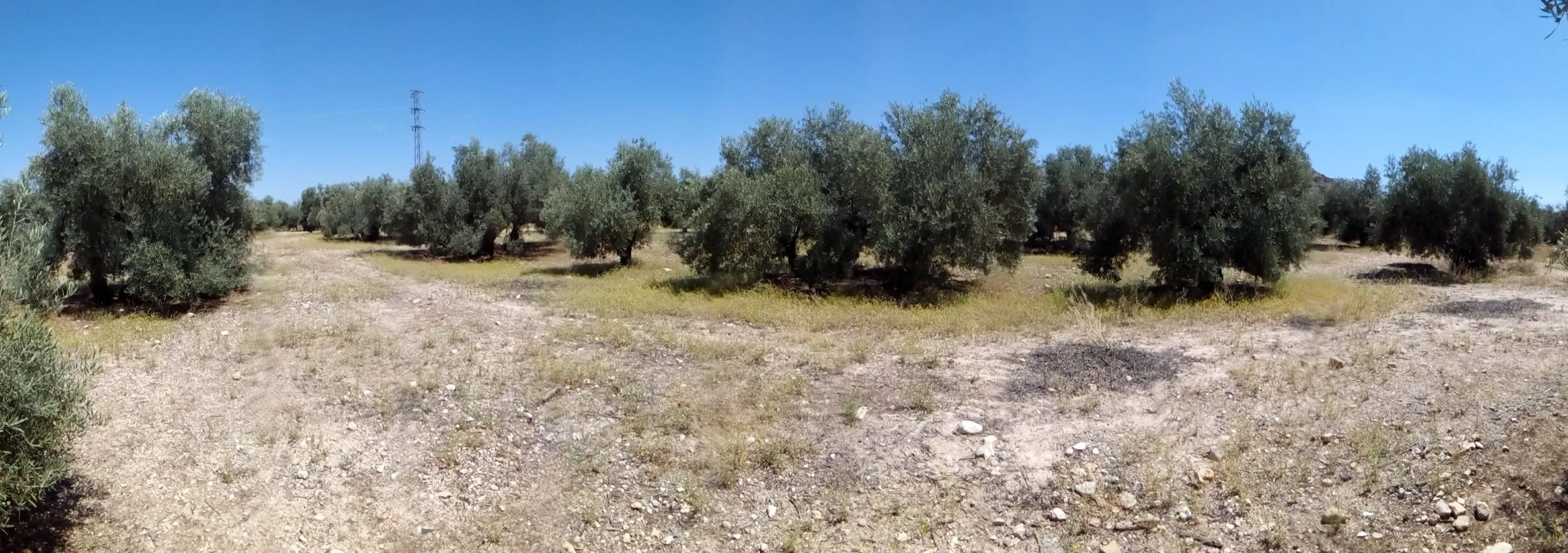
A thirsty tree makes less fruit and puts more into it. That is the whole mechanism. A rain-fed olive grove yields substantially less per hectare than an irrigated one, and the oil that comes out carries more body, more bitterness and more pungency. You are paying for the fruit that was never allowed to swell.
What makes this frustrating for buyers is that almost no label tells you which one you have. There is no legal box for it. Here is how to tell anyway, and what the difference is actually worth.
What water stress does to an olive tree
An olive is a fruit, and a fruit is mostly water. Give the tree plenty and it does the obvious thing: it sets more olives and each one grows larger, with more water inside relative to everything else.
Deny it, and the tree behaves defensively. It sets fewer fruit, each stays smaller, and the concentration of everything that is not water goes up — including the phenolic compounds that produce bitterness and the peppery catch at the back of the throat.
Those compounds are not there for our benefit. They are the tree’s chemical defence, making unripe fruit unpalatable so the seed inside is protected. A stressed tree invests more in that defence.
The measured effect is large. Research comparing the same variety grown with and without irrigation consistently finds substantially higher phenolic concentration in the rain-fed fruit — differences of a scale you can taste, not a rounding error.
There is a second consequence that matters for storage: those same phenolic compounds slow oxidation. A more concentrated oil keeps longer and handles heat better. Covered in how long olive oil lasts.
The trade-off, plainly
| Rain-fed | Irrigated | |
|---|---|---|
| Yield per hectare | Low | High, often several times higher |
| Fruit size | Smaller | Larger |
| Bitterness and pungency | More marked | Softer |
| Body | Fuller | Lighter |
| Keeping quality | Better | Less good |
| Year-to-year consistency | Variable | Steady |
| Cost per litre | High | Low |
| Water use | None | Considerable |
Look at the last three rows together, because they explain why so much of Spain’s olive grove has been irrigated over the past few decades. Irrigation is not cheating. It produces more oil, more reliably, at a price ordinary households can afford, and a well-made irrigated extra virgin is a perfectly good product.
What it does not produce is concentration. These are two different things being sold in the same aisle.
Why the fixed costs make it worse
Something people rarely account for: halving the litres does not halve the cost of running the grove.
Pruning, treatments, soil work and the labour of harvest all cost roughly the same whether the trees are carrying heavily or lightly. So dividing those fixed costs across half the output means roughly double the cost per litre before anything else has happened.
Add to that what usually accompanies dry farming in practice — sloping ground, widely spaced trees, no machinery access — and the gap widens further. On a steep hillside you cannot run the continuous harvesters used in hedgerow groves; you use a trunk shaker, or in the steepest parcels, poles and nets much as a century ago.
This is why rain-fed hillside groves are being abandoned across Spain. They give the most concentrated oil and the worst return per hectare, and that is a difficult combination to survive.
The water question behind all of this
There is a wider context that makes this more than a matter of taste, and it deserves stating without melodrama.
Inland Andalusia is a region of hot, dry summers and increasingly irregular rainfall. Over recent decades a large amount of olive grove has been converted to irrigation, because irrigation raises yields dramatically and makes the harvest predictable. That conversion has been rational for every individual grower and has put real pressure on shared water resources.
At the same time, dry-farmed hillside groves — the ones that use no irrigation water at all — are the least profitable and are being abandoned. The land that consumes nothing is the land going out of production.
We are not going to turn that into a sales argument, because it is more complicated than a slogan and because our own grove is rain-fed for the least noble reason available: there is nothing up there to water it with. But it is worth knowing that when you choose a rain-fed oil you are, incidentally, supporting the type of grove that is hardest to keep working.
The other side of the argument is equally real: irrigated production is what makes olive oil affordable for ordinary households, and a world of dry-farmed hillside oil only would be a world where most people cooked with something else.
Why no label tells you
Food labelling rules specify what must appear: the category, the origin, the quantity, the lot, the best-before date, the bottler’s details and storage conditions. A producer may voluntarily add the harvest date, the variety, the region.
Irrigation is simply not in the framework. Not in Spain, not in the EU. Nor is it covered by a PDO: within almost every Spanish denomination of origin you will find both rain-fed and irrigated groves, because the pliego governs area and process, not water. Explained further in what extra virgin actually means.
So a bottle that tells you is telling you voluntarily. In English you will see it phrased as rain-fed, dry-farmed or unirrigated — there is no settled term, which itself says something about how rarely it is stated.
How to work it out anyway
Four indirect signals, in rough order of reliability:
- Ask. If you buy direct from a producer, this is a normal question with a one-word answer. Anyone who grows their own knows immediately.
- Look at the terrain. Steep hillside groves in mountain areas are almost always rain-fed — frequently because there is simply nothing up there to irrigate with. Flat plains with regular tree spacing are usually irrigated.
- Look at the planting. Widely spaced traditional trees suggest dry farming: in poor soil without water, planting densely means none of them get enough. Hedgerow plantings are irrigated by necessity.
- Taste it. Not conclusive, since picking date affects intensity even more, but a notably full-bodied, bitter and peppery oil from a variety that should be gentle is a hint.
What it is not worth
Worth being straight about this, because dry farming has become a marketing word.
It does not rescue a badly made oil. If the fruit sat in a heap for three days before milling it will be fusty, and fusty overrides everything. If it was picked late, it will be soft regardless of how thirsty the tree was.
It is not automatically better than irrigated. A carefully made, early-harvest irrigated oil beats a carelessly made rain-fed one every time.
And it is not, on its own, an environmental claim. It genuinely uses no irrigation water, which matters a great deal in a region facing recurring drought. But the whole picture includes soil cover, treatments and transport, and one word does not settle it.
Ranked honestly, the things that determine what is in your bottle go in this order: no defects first, then picking date, then variety, then rain-fed or irrigated. Dry farming is the fourth lever, not the first.
What it means for how you store it
One consequence that follows directly and rarely gets connected.
Because rain-fed oils carry a higher phenolic load, and because those phenolic compounds act as a brake on oxidation while they are consumed, a concentrated oil keeps longer than a mild one under identical conditions. It also handles a hot pan better, for the same reason.
That has a practical implication for what format to buy. A large tin only makes sense if the oil in it is stable enough to survive months of gradual emptying, and concentration is one of the two things that determines whether it is — the other being variety, with Picual at the top of the range.
The reverse also holds: a soft, low-phenolic oil should be bought small and drunk young, regardless of how good it was on day one. The full storage picture is in how long olive oil lasts.
Where we sit
Our grove is on the slope above Marmolejo, in the foothills of Sierra Morena in Jaén, and it is never watered. We would rather not dress that up as a philosophy: up there, there is nothing to water it with.
It is Picual and only Picual, picked green, milled the same day and cold extracted below 27 °C. There is no PDO — none of Jaén’s four denominations reaches this stretch of the province, and we say so openly, though Marmolejo does fall inside the province-wide «Aceite de Jaén» PGI. The regional map is in Jaén olive oil: regions and PDOs.
What that adds up to in the glass: green fruitiness, clear bitterness, and a pungency that arrives a second after you swallow and sometimes makes you cough. If you are coming from mild supermarket oils, try it on warm toast with a little salt before deciding — that is where an intense oil makes sense to a new palate.
500 ml bottle
Dark glass. Our everyday size.
€12.50€25.00 per litre
See the half-litre bottleFrequently asked questions
- What does dry-farmed olive oil mean?
- It means the grove is never irrigated and lives on rainfall alone, which in inland Andalusia means going properly thirsty through the summer. The tree responds by setting less fruit and concentrating more into each olive. In Spanish the word is secano, and there is no single agreed English term: you will see rain-fed, dry-farmed and unirrigated used for the same thing.
- Is rain-fed olive oil better?
- It starts with real advantages rather than guaranteed superiority. Water stress tends to produce oils with more body, more bitterness and more pungency, and studies comparing the same variety with and without irrigation find substantially higher phenolic concentrations without water. But dry farming does not rescue an oil picked late or milled three days after harvest.
- Why do labels not say whether the grove is irrigated?
- Because there is no legal box for it. Labelling rules cover category, origin, quantity, lot and best-before, and a producer may voluntarily add harvest date or variety. Irrigation is simply not part of the framework, in Spain or in the EU. If a bottle tells you, it is because the producer chose to, which is usually a sign there is something worth telling.
Keep reading
- Picual, Arbequina, Hojiblanca and Cornicabra: which one is for youThe four big Spanish olive varieties compared: how each one tastes, what it suits in the kitchen, and which keeps best in the bottle.
- Why Jaén produces more olive oil than any country in the worldSixty-six million olive trees in a single province: how it came about, what makes it possible, and the cost of depending on one crop.
- What extra virgin actually means, and how it differs from virgin and refinedThe three legal categories of olive oil, what separates them, and why the word on the label is the only claim that cannot be fudged.
Want to taste it?
Everything on these pages ends up in the same bottle: rain-fed Picual from Marmolejo, picked green and milled the same day.
See sizes and prices