How to read an olive oil label: the seven things that matter
What to check on a bottle of olive oil before you pay, in what order, and which impressive-sounding claims mean absolutely nothing.
Written by The Villafranca Bonilla family8 min read
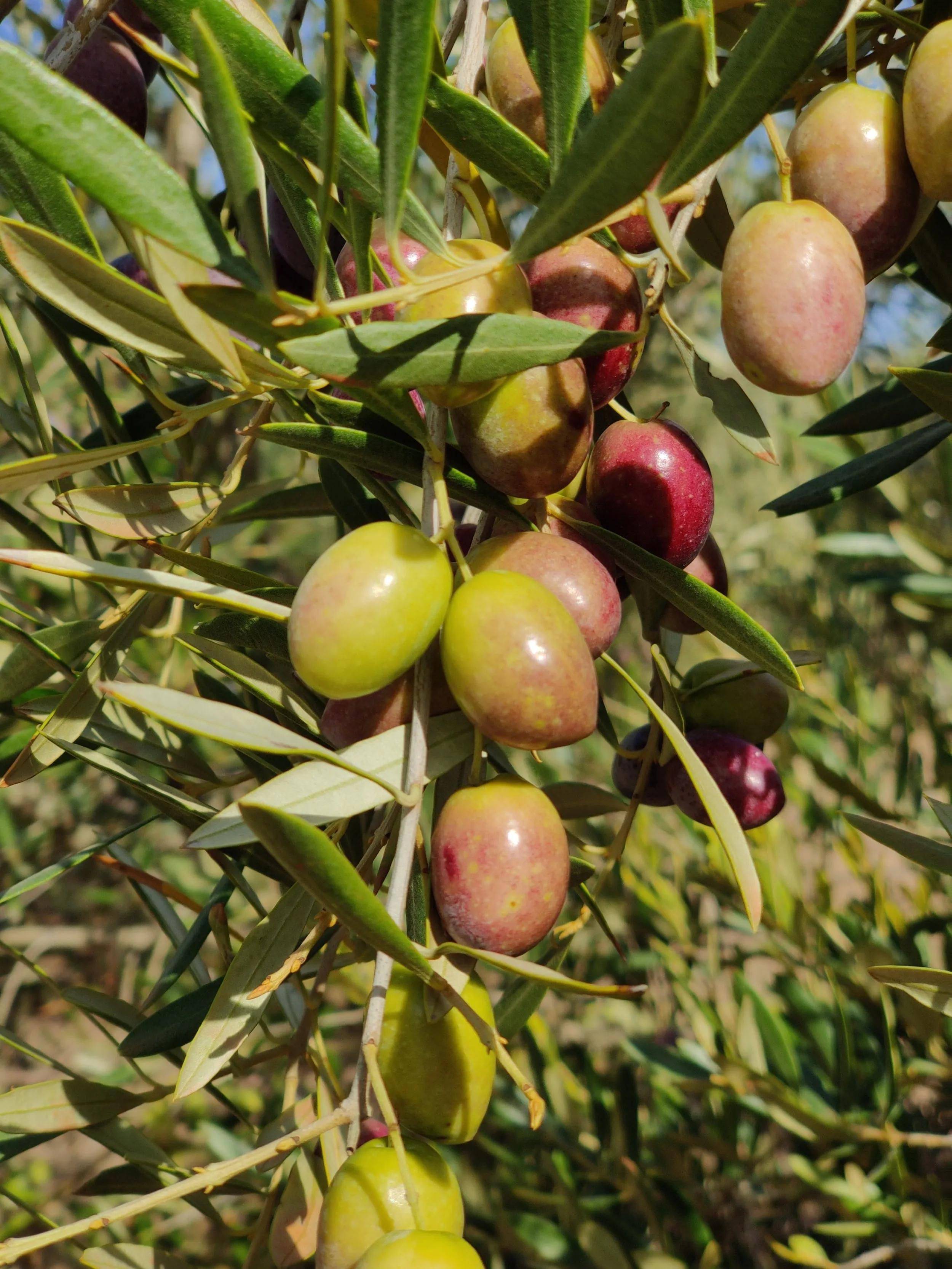
Thirty seconds, in this order: category, origin, crop year, best-before, bottler, variety and container. Those seven tell you almost everything a bottle can, and once you have them the large claims on the front stop mattering. The information is on the back, in small type.
This matters more if you are buying Spanish oil abroad, where the front label is doing a lot of work and the shelf turnover may be slow.
1. The category: the one word that cannot lie
First and most important. There are three different products in a supermarket aisle, and they are not grades of the same thing.
- Extra virgin olive oil. Mechanically extracted olive juice, free acidity below 0.8 %, and zero defects in a panel tasting.
- Virgin olive oil. Same process, but the panel found a fault. Acidity up to 2 %.
- “Olive oil” plain, sometimes mild or intense. A blend of refined oil with a little virgin. The refined part is produced with heat and solvents and arrives with no flavour, aroma or colour.
That last one causes most of the confusion because “olive” is right there in big letters. Look at what it does not say: no extra virgin in the legal name means it is not extra virgin.
Two more on the neighbouring shelf: olive pomace oil is not made from the olive but from what remains after pressing, using solvents. And lampante virgin oil cannot be sold to consumers at all — it goes straight to a refinery.
The category is regulated word by word. Everything else on the front — selection, gourmet, premium, traditional — has no legal meaning whatsoever. Full detail in what extra virgin actually means.
2. Origin: where the fruit grew, not where the factory is
For virgin oils, declaring origin is mandatory. For refined “olive oil” it is not, which is why it often does not appear.
The permitted wordings are a closed list, and worth recognising at a glance:
| What you read | What it means |
|---|---|
| Origin: Spain | Olives harvested and milled in Spain |
| Origin: European Union | Any EU country, or several |
| Blend of olive oils from the European Union | Several EU countries, unspecified |
| Blend of olive oils not from the European Union | From outside the EU |
| Blend of EU and non-EU olive oils | Any combination of the two |
| Obtained in X from olives harvested in Y | Picked in one country, milled in another |
Those “blend” formulations are the most revealing small print on the shelf. They are not illegal and not a fraud: they describe exactly what is there, which is bulk oil bought from several origins and unified at a bottling plant. What you cannot know from that point on is the crop year, the variety, or how many separate growers contributed.
The classic trap: the brand carries the name of an Andalusian village, the label is full of sunlit countryside, and the back says “blend of olive oils from the European Union”. It is legal, and it is also everything you need to know.
A PDO narrows origin further — a defined region and a set of rules with an inspection body behind it. A PGI covers a wider area: the «Aceite de Jaén» PGI, for instance, spans all 97 municipalities of the province. Ours carries no PDO — Marmolejo falls outside all four of Jaén’s denominations, though it does sit inside that PGI — and we say so plainly. The regional map is in Jaén olive oil: regions and PDOs.
3. The crop year: the voluntary item that says most
Here is the asymmetry worth understanding: the harvest date is not required. The only date the law demands is the best-before.
An oil from the 2024/25 crop can be bottled in September 2026 and carry a best-before into 2028. All correct, all legal — and you are buying an oil nearly two years old.
So when a bottle says “Harvest 2025/26” or “Picked in October”, that information is doubly valuable: for what it says, and because nobody obliged them to say it. Nobody prints the crop year of an old oil.
If it appears nowhere, there is an indirect route: subtract eighteen months from the best-before. That is the shelf life usually assigned to an extra virgin, so the arithmetic gets you close to the bottling date. Not exact, but it rules out the worst.
4. The bottler: who answers for what is inside
Every label carries a name, an address and a health registration number. That is who is legally responsible for the product.
The interesting move is to cross-reference it with the origin:
- If the bottler sits in the same region as the declared origin, there is a fair chance the same people grew and bottled it.
- If the origin says “Spain” and the bottler is on an industrial estate five hundred kilometres from any olive grove, that does not make the oil bad — but it has passed through a longer chain: grower, mill, bulk trader, bottler, brand.
Watch for the phrase “bottled for…”: it means the brand on the front is not the one doing the bottling. Standard practice for own-brand and for marketing brands with no grove behind them.
5. The variety: what decides how it tastes
Also voluntary, and also telling by its mere presence. A single-variety oil can be described; an unspecified blend cannot.
The four big Spanish varieties give oils that bear no resemblance to each other:
- Picual. Intense green fruitiness, marked bitterness and pungency, tomato leaf and olive leaf. The most stable of the four against heat and time.
- Arbequina. Soft, sweet, almondy. Wins people over quickly and keeps less well.
- Hojiblanca. Middle ground, grassy, with a slightly astringent finish.
- Cornicabra. Powerful, with body, somewhat more aromatic than Picual.
None is better; they are for different jobs. Compared in full here.
6. The container: tin or dark glass
Light is the number one enemy of olive oil, and a clear container leaves it defenceless on a shelf under a strip light burning fourteen hours a day.
Best to worst: tin (completely opaque), dark glass, dark PET, clear glass. A clear plastic jug in a lit aisle is the worst place an oil can be, which is why there is rarely a good one there.
Format matters too, for a different reason: once opened, air governs everything. Five litres makes sense if you get through five litres.
7. Acidity, if they print it
The free acidity — that “0.2°” you sometimes see — cannot be tasted. It has no flavour. It is a chemical indicator of fat breakdown, and on its own it tells you whether an oil is sound, not whether it is good.
There is a little-known and very useful rule: if a label declares the acidity, it must also declare the peroxide value, the waxes and the ultraviolet absorbance. All four, or none.
So when you see a bottle with a large “0.2°” on the front and no other number on the back, you know that figure is there as a sales argument rather than as information.
Claims that sound good and mean nothing
A quick pass through what fills the front label:
- “First cold pressing”. Almost nobody presses any more — modern mills centrifuge, and only once. The regulated term is cold extraction, requiring the paste to stay below 27 °C.
- “Pure” / “100 % pure”. No such category exists. Usually found on refined oils.
- “Mild” and “intense”. They describe the flavour of a refined oil, not quality.
- “Artisanal”, “gourmet”, “selection”, “reserve”. No legal definition in olive oil. Anyone may print them.
- “From our own groves”. Only means something if it says which.
- Medals and competitions. Real, but there are a great many contests and most charge to enter. A medal is not an analysis, and it belongs to one batch of one year.
None of this is dishonest. It simply occupies the space where the crop year and the variety could have been.
The thirty-second check
At the shelf, without overthinking it:
- Does it say “extra virgin”? If not, put it down.
- Turn it round and find the origin. “Blend of EU olive oils” tells you what you are buying.
- Find the crop year. Latest or previous. If absent, subtract 18 months from the best-before.
- Find the variety. If named, you know how it will taste.
- Check the container. Dark or tin.
- Cross-reference bottler and origin. Same place?
That eliminates most of the aisle in under a minute, and what remains is a matter of taste and budget.
What no label will ever tell you
Three things that decide more than anything above, and appear on no bottle:
When within the season the fruit was picked. Green October fruit and black January fruit from the same grove and variety are two different oils.
How long it took to reach the mill. Olives heaped for days ferment, and the oil is compromised before extraction begins.
Whether the grove is irrigated. It changes the concentration of everything that gives bitterness and pungency, and there is no legal box for it. See rain-fed versus irrigated.
You only learn those if someone tells you. Which is why we write that we pick green, mill the same day and never irrigate — not as marketing, but because it does not fit on a bottle.
500 ml bottle
Dark glass. Our everyday size.
€12.50€25.00 per litre
See the half-litre bottleFrequently asked questions
- What information is legally required on an olive oil label?
- The category, the origin in the case of virgin oils, the quantity, the best-before date, the name and address of the bottler, the lot number and storage conditions. Everything else is voluntary — and the voluntary items are precisely the ones you most want: the crop year, the variety and whether it comes from a single estate.
- Why do so many bottles not show the harvest date?
- Because it is not required. The only date the law demands is the best-before, which is counted from bottling rather than from picking. An oil can sit in a tank for months before it goes into a bottle and emerge with a long date printed on it. When a brand does print the crop year, it is almost always because it has a recent one to show.
- What does "bottled at origin" mean?
- That the oil was bottled in the same area where it was produced, without passing through an outside bottling plant. It is not an official certification and does not guarantee quality on its own, but it shortens the chain and usually means the producer and the bottler are the same people. To check, see whether the bottler address matches the declared origin.
Keep reading
- What extra virgin actually means, and how it differs from virgin and refinedThe three legal categories of olive oil, what separates them, and why the word on the label is the only claim that cannot be fudged.
- Does olive oil go off? How long an opened bottle lastsBest before versus expiry, how long an opened bottle really holds up, and the clear signs that an oil has gone rancid. Plus how to store it.
- Picual, Arbequina, Hojiblanca and Cornicabra: which one is for youThe four big Spanish olive varieties compared: how each one tastes, what it suits in the kitchen, and which keeps best in the bottle.
Want to taste it?
Everything on these pages ends up in the same bottle: rain-fed Picual from Marmolejo, picked green and milled the same day.
See sizes and prices